Don't Buy Until You Read This: Tribler vs Logitech G Heavy Equipment Bundle
The world of specialized simulation peripherals has expanded rapidly over the last several years. No longer are enthusiasts limited to standard flight sticks or racing wheels. Today, niche markets catering to agriculture, construction, and heavy machinery simulation have taken center stage. For those who spend their hours meticulously plowing fields in Farming Simulator or navigating complex construction sites in specialized industrial sims, the choice of hardware is often the difference between a frustrating chore and a deeply immersive professional experience. Two names often arise in these circles for very different reasons: the Logitech G Heavy Equipment Bundle and the newer, boutique-focused Tribler system.
Choosing between these two requires a deep understanding of what a heavy equipment operator actually needs from their hardware. Unlike racing, where high-speed force feedback and rapid steering ratios are paramount, heavy equipment simulation prioritizes precision, multi-axis control, and the tactile sensation of hydraulic management. This article provides a comprehensive analysis of both systems to help you decide which investment deserves a spot on your desk and which might leave you wishing for more specialized control.
The Evolution of Simulation Controls
To understand the current market, one must look at the history of dedicated controllers. For years, players used flight sticks to simulate the booms of cranes or the loaders of tractors. While functional, the "feel" was never quite right. Logitech, in partnership with Saitek, changed the landscape by introducing a bundle specifically designed for the Farming Simulator franchise. It remained the undisputed king of the niche for nearly a decade simply because there was no direct competition. However, the rise of high-end boutique manufacturers like Tribler has challenged the status quo, offering more robust build quality and advanced sensor technology that the mass-market Logitech unit lacks.
Detailed Analysis: Logitech G Heavy Equipment Bundle
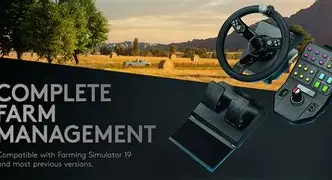
The Logitech G Heavy Equipment Bundle is a three-part system consisting of a dedicated steering wheel, a side panel with a multifunctional joystick, and a set of floor pedals. Often referred to by its legacy name, the Saitek Farm Sim Controller, this bundle was built from the ground up to solve the specific ergonomic challenges of agricultural simulation.
The wheel itself is unique. Unlike a racing wheel that might be 11 or 12 inches in diameter with a thick, contoured grip, the Logitech wheel is designed to look and feel like it belongs in a tractor. It features a turn knob, allowing for one-handed steering while the other hand operates the hydraulic controls on the side panel. The 900-degree rotation mimics the steering rack of a real vehicle, providing enough range for fine maneuvers in tight barnyards.
The crown jewel of the Logitech bundle is the Side Panel. This piece of hardware features a six-axis joystick and over two dozen programmable buttons. In real-world use cases, this allows a player to control a front loader, a logging crane, or a combine harvester header with fluid, intuitive motions. The integration with games like Farming Simulator is essentially "plug and play," meaning you spend less time in the settings menu and more time in the field.
Pros and Cons of the Logitech G Bundle
- Excellent ergonomics specifically tailored for agricultural machinery with the included steering knob.
- High button density on the side panel allows for nearly every game function to be mapped to a physical switch.
- Plug-and-play compatibility with major simulation titles, featuring pre-configured control schemes.
- Cost-effective entry point for a complete "cockpit" experience in one box.
- The plastic construction can feel lightweight and "toy-like" during intense use.
- The internal spring-centering mechanism for the wheel can be noisy and lacks the smoothness of belt-driven systems.
- Pedals lack high-end load cell technology, relying on basic potentiometers that may wear over time.
Detailed Analysis: The Tribler System
Tribler represents a different philosophy in simulation. Where Logitech aims for accessibility and "all-in-one" convenience, Tribler targets the enthusiast who demands industrial-grade durability and high-fidelity sensor response. Tribler hardware is often sold in components or as a "pro" kit that prioritizes metal construction and contactless Hall Effect sensors over the quantity of plastic buttons.
The Tribler approach to a heavy equipment wheel often involves a heavy-duty motor base and a rim that shares more DNA with a real-world truck steering wheel than a gaming peripheral. The focus here is on the resistance and the weight of the steering. In heavy machinery, the steering isn't just about turning; it’s about feeling the weight of the load. Tribler’s systems use higher torque motors that can simulate the resistance of hydraulic steering systems more accurately than the spring-based Logitech wheel.
Furthermore, the Tribler joystick modules are built with heavy-duty gimbals. In a real excavator or feller buncher, the joysticks are subjected to constant force. Tribler mimics this by using metal components that won't snap under pressure. This is a crucial consideration for professional trainers or enthusiasts who plan to use their equipment for several hours every day for years to come.
Find top-rated Electronics products at great prices.
See Deals →Pros and Cons of the Tribler System
- Superior build quality using aluminum, steel, and high-density polymers for a professional feel.
- Hall Effect sensors provide infinite precision and won't develop "drift" or dead zones like potentiometer-based systems.
- Force feedback is more nuanced, allowing the user to feel the vibrations of the engine and the resistance of the ground.
- Modular design allows users to upgrade individual components rather than replacing the entire bundle.
- Significantly higher price point that may be prohibitive for casual or beginning players.
- Requires a more involved setup and calibration process to get the most out of the high-end sensors.
- Limited availability compared to mass-market brands, often requiring direct orders from the manufacturer.
Direct Comparison of Specifications
A side-by-side look at the technical specifications reveals the fundamental differences between these two contenders. It highlights where the value lies for different types of users.
| Feature | Logitech G Heavy Equipment Bundle | Tribler Pro Series |
|---|---|---|
| Primary Construction | High-impact Plastic | Metal and Industrial Polymer |
| Sensor Type | Potentiometer / Optical | Hall Effect (Contactless) |
| Wheel Rotation | 900 Degrees | 900 - 1080 Degrees (Adjustable) |
| Joystick Axis | 6-Axis (Spring Centered) | 8-Axis (Adjustable Tension) |
| Customization | Limited to button mapping | Physical tension and modular swapping |
| Feedback | Passive centering / basic vibration | Dual-motor Force Feedback |
| Mounting Options | Desk Clamps (Integrated) | Bolt-on / Professional Rig Ready |
Real-World Use Cases: Farming vs. Construction
When deciding between these two, the specific "flavor" of simulation you prefer is a major factor. Let's look at how these peripherals perform in the two most popular heavy equipment niches.
Agricultural Simulation (Farming Simulator)
The Logitech G bundle was literally designed for this game. If your primary goal is to drive tractors, pull trailers, and manage a farm, the Logitech system offers an unmatched level of convenience. The turn knob on the wheel is a game-changer for backing up long trailers, an action that requires constant, small steering adjustments while looking over your shoulder (or at a secondary monitor). The side panel makes switching between tools—lowering a header, unfolding a seeder, or turning on a slurry tanker—fast and tactile. For the casual farmer, the Logitech is usually the right choice because the plastic build is sufficient for the relatively low-stress inputs of farming.
Technical Construction & Excavation (Construction Simulator / Gold Rush)
This is where the Tribler system begins to pull ahead. Construction simulation involves a lot of "fine motor skills" using joysticks. When you are trying to seat a concrete pipe into a tiny trench, the "stepped" feeling of a cheaper potentiometer-based joystick can lead to jerky movements and dropped loads. Tribler’s contactless sensors provide a smooth, linear curve of input. This means when you move the stick 2%, the machine moves 2%. In the Logitech, there is often a physical "dead zone" or a sudden jump in input which can be frustrating in high-precision construction scenarios. Buyers who prioritize excavator work or crane operation will find the Tribler’s durability and precision worth the premium.
Buying Guide: What to Look for in Heavy Equipment Controls
Before committing to either system, consider the following environmental and ergonomic factors that often go overlooked in the initial excitement of a purchase.
1. Desk Space and Mounting: The Logitech bundle is a space hog. Between the wide wheel base, the side panel, and the pedals, you need a significant amount of desk real estate. The clamps are solid but require a desk edge that isn't too thick. Tribler systems often assume you have a dedicated simulation rig. While they can be desk-mounted, their weight and torque often require a more permanent, bolted solution to prevent the hardware from shifting during use.
2. Pedal Preference: Many heavy equipment enthusiasts find pedals to be the weakest link in any bundle. In a tractor or truck, you aren't slamming on the brakes like a Formula 1 driver; you are feathering the throttle and using the clutch for smooth starts. The Logitech pedals are functional but very light, often sliding around on hardwood floors if not secured. If you already own high-quality racing pedals (like those from a Fanatec or Thrustmaster setup), you might prefer buying a standalone Tribler Side Panel rather than the full Logitech bundle.
3. Software Ecosystem: Consider how much time you are willing to spend in software managers. Logitech’s G Hub software is standard and generally reliable, though it can occasionally struggle with older titles. Tribler, being a more niche manufacturer, sometimes requires third-party mapping software like JoyToKey or specialized drivers. If you aren't tech-savvy and just want things to work out of the box, the mass-market support of Logitech is a safer bet.
Find top-rated Electronics products at great prices.
See Deals →4. Tactile Feedback: Do you want to feel the machine? Most heavy equipment doesn't have "active" force feedback in the way a sports car does, but it does have weight and vibration. The Logitech wheel is mostly passive. The Tribler system can be tuned to provide a sense of the engine’s RPM through the wheel and stick, which adds a layer of "sensory immersion" that helps you operate the machine by ear and feel rather than just by sight.
The Verdict: Professional Grade vs. Enthusiast Value
The choice between Tribler and the Logitech G Heavy Equipment Bundle ultimately comes down to your level of commitment to the hobby and your tolerance for plastic-versus-metal construction. They represent two different tiers of the simulation experience.
The Logitech G bundle remains the best "value proposition" for the majority of players. It provides a complete 360-degree experience that transforms Farming Simulator from a keyboard-and-mouse chore into an engaging hobby. While its longevity might be questioned by "hardcore" users, for several hundred hours of gameplay, it performs exactly as advertised. It is the logical choice for the hobbyist farmer who wants the specific layout of a tractor cab without breaking the bank.
The Tribler system is for the user who views their PC as a workstation for virtual industrial operation. If you take pride in the surgical precision of your crane work or the perfect grade of your bulldozer passes, the Logitech's limitations will eventually frustrate you. Tribler offers the reliability of industrial-grade components and the precision of modern sensor tech. It is a "buy once, cry once" investment that will likely outlast several generations of PC hardware.
When making your final decision, consider the "secondary market" as well. Logitech units hold their value well because of their name brand and demand, making them easy to resell if you decide the hobby isn't for you. Tribler gear is harder to find but prized by the community, often selling for near-retail prices even when used. Whichever path you choose, moving away from a standard game controller and into dedicated heavy equipment hardware is the single biggest upgrade you can make to your simulation journey.
In the end, heavy equipment simulation is about the joy of the process—the slow, methodical completion of a job well done. Having the right tools in your hands doesn't just make the game easier; it makes the labor feel real. Whether you choose the accessible, all-in-one convenience of the Logitech G bundle or the uncompromising precision of the Tribler system, you are stepping into a world where the hardware finally matches the scale of the machinery you are operating.